# Share a phone with a teammate
Join a team server, make a phone a team phone, let a teammate book it and take it back when you need it.
A team phone stays on your desk and on your Mac. A teammate books it from their own Mac through your team's relay, sees its picture, and drives it, while asks still come to you. This guide walks both sides.
The relay is private: each team runs its own. If your team has none yet, start with [Run your own relay in 30 minutes](/guides/run-your-own-relay/) or the [self-hosting page](/self-host/).
Time: about 15 minutes.
You need:
- A team server address, such as `relay.example.com`.
- Two people, each with Silan on a Mac and an account on the team's sign-in.
- One phone set up on the owner's Mac.
## Steps
On the owner's Mac:
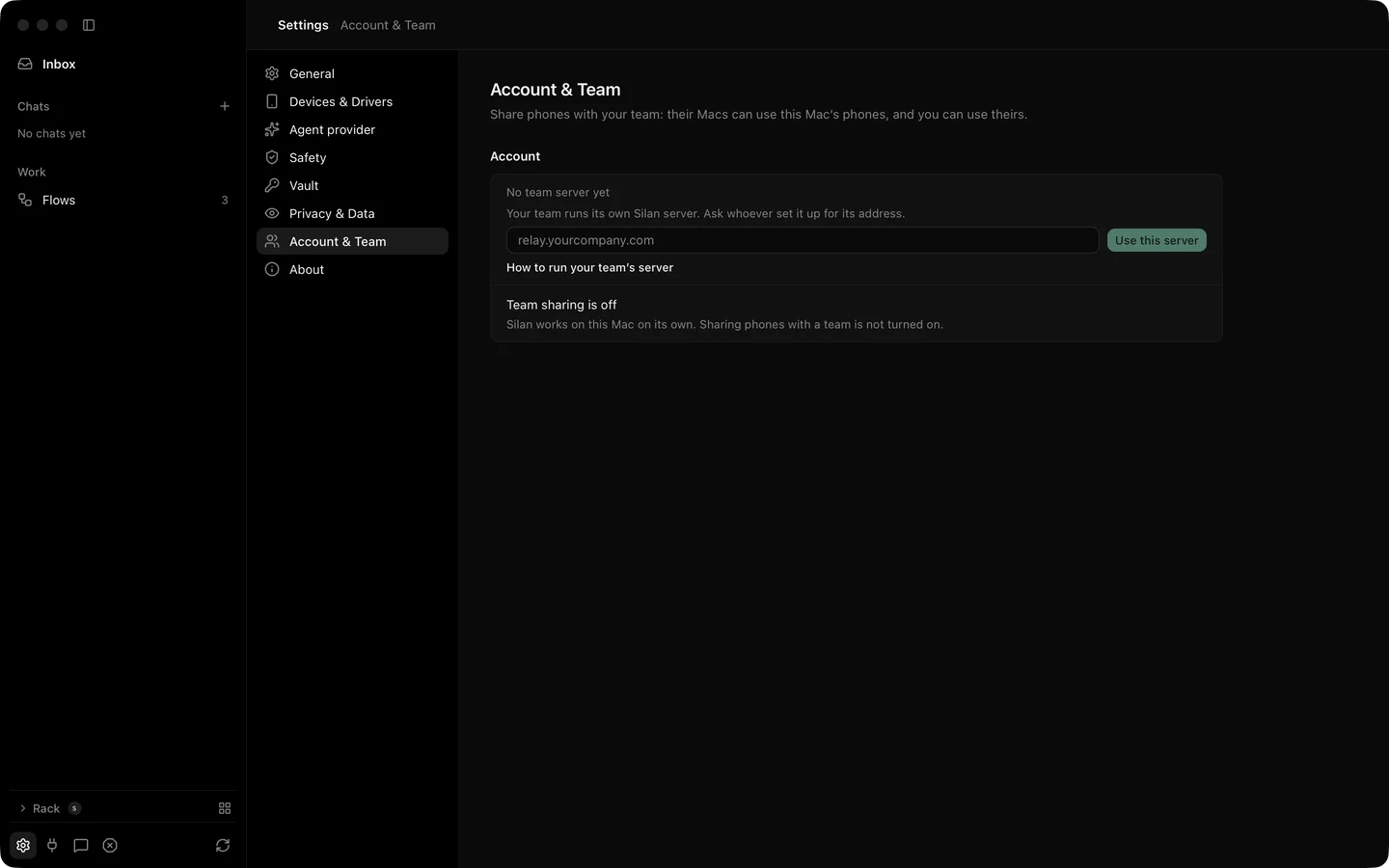
1. Open **Settings › Account & Team**. Under **No team server yet**, type the server address and click **Use this server**.
2. Click **Sign in**. Your browser opens the team's sign-in page. Sign in and come back to Silan. The page now reads **Server: relay.example.com** with a **Change…** link, and your name.
3. Make or join the team. If a teammate sent you an invite link, open it: the server address and the team fill in by themselves.
4. Click the phone in the sidebar, then **Info** in the device column. Under **Who may use it**, tick **Share with** your team. Set **People at once** to 1 unless the phone should take more than one teammate.
Settings, Account and Team: add the team server, then sign in to start a team, join with an invite, or hold phones for the team.
On the teammate's Mac:
5. Open **Settings › Account & Team**, use the same server and sign in. Join the team from the invite link.
6. Look at the sidebar. The owner's phone shows under the team with a row such as `Owner's MacBook · Free · 1 seat`. Click **Use**.
7. Watch the notice: ** is yours. Start within 2 minutes.** The phone's page opens with its live picture through the relay. Tap and type as if it sat on your desk.
8. Give it back when you are done with **Hand back**. Silan returns the phone to its Home screen when the next person is someone else.
Back on the owner's Mac:
9. Watch **Activity** while the teammate works. Each step is listed with the teammate's name and Mac, such as "Kai, from Kai's MacBook". If the teammate's agent needs an answer to a risky step, the ask comes to your **Inbox**.
10. Take the phone back when you need it. Open the phone's page and click **Take back**. Give a reason, which the teammate sees. The teammate gets two minutes of grace, then the phone is yours again.
Waiting in line: when the phone is in use, the row reads `In use by · N waiting`. **Join the queue** puts you in line, **Leave the line** takes you out, and **Ask to hand over** sends the current user a nudge. After 15 minutes of no touches Silan asks the user **Still using ?** and takes the phone back if nobody answers in two minutes.
## If something goes wrong
- **The teammate sees no team phones.** Both Macs must point at the same server and both people must be in the same team. Check **Settings › Account & Team** on each.
- **The picture is slow.** The relay adds about 26 ms to each frame and gives about 28 frames a second. Slower than that points at the network between the Macs and the relay.
- **The phone went to the Home screen.** That is on purpose. Silan clears the screen when the phone changes hands between two different people.
- **A booking lapsed.** The two-minute start window passed. Click **Use** again.
:::note[Proof]
Proved on an iPhone 11 (iOS 27) on a cable, 2 Nov 2026, by Silan workers with two real accounts on two Macs: run `20261102-022440-79826` covered sign-in, sharing, booking, the waiting line, hand back and take back, with the owner's Activity naming the teammate. Source: verify-silan feature map, team-phones and team-link, and use-case facts.
:::